|
THE PANAMA CANAL TRAMSIT The following is my experience of transiting the Canal from the Caribbean to the Pacific
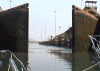
BASIC INFORMATION You sail into Colon and head for the yacht anchorage which is clearly marked in pilot books and charts. It is important that you anchor within the area of the 4 buoys marking the yacht anchorage as big ships manoeuvre in the area. If you anchor outside the proscribed limits you may be towed off by a tug and fined by the Canal Authority. Very occasionally there are spaces available at the Colon Yacht Club marina. It is small. You can land your dinghy at the Yacht Club dinghy dock and get fresh water there as well as fuel. The Club officials are very helpful and the bar/cafe is the cruisers meeting place. Your boat must be capable of 4 knots under engine. Sails are not permitted in lock areas although you can motor-sail across the lakes. You have to declared your cruising speed in order for the authority to decide if you are potentially a one day transit. If you declare a higher speed than you can make they are not amused as it throws out their scheduling of 'onboard advisors'. Better to be truthful as the minimum speed allowed is 4 knots and most boats can make that. CREW: If you are looking for crew for the canal transit and on into the Pacific this is the place you will find them - on the Yacht Club notice board and by word of mouth. Always people looking to crew either just through the canal or to Galapagos - Tahiti etc. REGISTERING TO TRANSIT: The easy way and costs vary is to have an agent arrange the transit for you. If you do it yourself it will take about a day and a half. Photocopies are the answer to speeding up the process - every paper connected with the transit - passports, crew lists. ships papers, require numerous photocopies - Photo copy shops in Colon. The office of the Yacht Club will start you out on on the paper trail - there are 4 or 5 different offices to visit in order to register for the transit - they all have forms to fill in and all require photo copies of everything including the forms you got from the previous office. Be calm - have a sense of humor - and the folks are nice and will tell you where to go next... It all culminates in a Bank - only in the morning between 08.00 and 14.00, where you hand a cashier all the paperwork and your credit card (or cash but I do not advise carrying that amount in Colon) - he debits the card a lump sum of US$1300 (in 2001) This is made up of the fee $500 and the 'Buffer' $800. The buffer is in case you damage Canal Authority property (unlikely) or require the services of a tug (happens). The $800 is returned to your credit card account once you have successfully completed the transit. The reality of this is you will not see the $800 for at least 3 months. You will get it but not for a long time. If you do not have a credit card it is difficult - you need to get the cash refund transferred to a bank account in your name and overseas transfer charges are high. A few days after the fee and deposit is paid you will be informed of the arrival of an inspector who completes the 'panama registration' and makes certain your boat is capable of transiting the canal without causing problems to other users, check the equipment and get you to sign a disclaimer in which you admit your the chock and bits do not meet the requirements for the canal. Your mooring lines may not be of sufficient strength. Your engine may not be powerful enough in a strong current. Your boat can be damaged by huge great steel pilot boats coming alongside and it is up to you to have sufficient fenders. Frankly most of the statements are true in the case of most small yachts.......... Having signed the disclaimer you can then decide if you want to transit centre chamber, sidewall, alongside a Panama tug, nested with other yachts. If you agree to all of the methods you will probably get a slot to transit sooner than if you specify one or two particular systems. The hire the speed you can maintain the more quickly you will be slotted for transit - but be careful to be truthful because of reasons stated above. TRANSIT EQUIPMENT: You are required to have 4 line handlers on board in addition to the skipper. You will find other line handlers fairly easily from other yachts who are waiting to transit (the waiting time can be 10 days from when you have paid the deposit) Most yachts 'line handle' for the boats ahead of them travelling back from Balboa by coach. Gives the skipper and crew a chance to see what really happens. If you are unlucky there are local people who hire themselves out as line handlers for a fee and travel expenses. You are required to have 4 x 125 ft warps of at least 1inch diameter. Sometimes boats can share warps in order to make up the four. In the end the easiest solution is to hire the four warps from the yacht club. They have several sets of 4 used for the purpose. As soon as you know your transit date you should book the warps as they can run out. I seem to remember the fee was something like $5 or $10 each warp but they did want a deposit of $100 for when you returned them - in fact they collected mine from me in Balboa. Theoretically the 4 warps should be on board your boat when you are 'inspected' prior to transit but the inspectors know you will hire and if you did not have them on board when they are required they would just tie you to a tug and use the 'buffer' to pay for it! You are also required to have a HORN, Be able to ANCHOR, have a TOILET and DRINKING WATER. You will be expected to provide meals for the 'Advisor' drinks and snacks. Failure to do so just means they take it out of your 'buffer' at a commercial rate. If you do not have ice then the 'advisor' can be asked to bring some with him for a very (if any) small charge. You will have to feed 6 people - Advisor, 4 line handlers & skipper anyway and provide soft drinks - the advisor has dinner at home but expects lunch on both days of the transit
On the following link is the information provided in the Official Panama Canal publication for transiting in yachts. It has fees, rules and regs, details of locking procedures. On this link is a copy of the release and indemnity form you have to sign. No option!
This links you to the web cam at GATUM LOCK on the Panama Canal http://www.pancanal.com/eng/photo/camera-java.html
|